
The Original Taymouth Castle Hotel – Part 1
In 1920, with mounting debts, punitive new inheritance tax demands, and the prospect of expensive renovation bills imminent, the Marquis of Breadalbane, Sir Gavin Campbell, was left with no option but to place his family’s castle and ancient estates on the market. In 1871, he had inherited close to half a million acres. By 1920, only 60,000 acres remained.
His timing could not have been worse. In the depressed postwar property market – when taxes were high and savings exhausted – many titled Scottish families were left with little choice but to sell their stately homes and lands, depressing property prices even further. According to The Scottish Register of Sales and Estates, no less than 175 estates were placed on the market in 1920 and 1921.
In August 1920, the Taymouth Castle Estate was placed on the open market. The intended sale sent shockwaves through the local community. The following announcement be placed in newspapers across the country:
TAYMOUTH CASTLE FOR SALE
The Marquis of Breadalbane has decided to sell Taymouth Castle and a portion of his estate lying in the neighbourhood of Kenmore, Fortingall, and Aberfeldy, and has instructed Messrs Knight, Frank. and Rutley to dispose of them at early date. Included in the sale are the shootings of Remony, Tombuie, Bolfracks, Moness, Glenquaich, Lochan. Duneaves, Drummond Hill, and Kynachan, providing some of the best all-round sport in Perthshire. There is excellent salmon and trout fishing in the rivers Tay and Lyon. Several good farms will be included in the sale, also hotels at Aberfeldy, Kenmore, Amulree, and Fearnan.
However, the difficulty in selling the palatial Taymouth Castle Estate as a whole quickly became apparent. No buyer could be found prepared to take on the entire spread. One of the stumbling blocks to the sale had been Sir Gavin’s refusal to have electricity installed at the castle (even though many in the surrounding area had already converted to electric lighting and power). His chastened financial circumstances forced him to provide illumination for his guests via the estate’s gas supply. The huge maintenance costs involved in modernising such an enormous estate were now well beyond the cash-strapped Marquis. At his instruction, Messrs Knight, Frank, and Rutley arranged an auction in December 1920, at the Hanover Square Auction Rooms in London, in which the sale of the estate was to be offered in smaller lots.
An extensive prospectus for the sale was prepared, which now offers us some insight into the value of the vast estate and the anticipated rental income for any purchaser:
HISTORIC PERTHSHIRE MANSION FOR SALE
Great interest is being manifested throughout Scotland in the impending sale of the famous Taymouth Castle estates belonging to the Marquis of Breadalbane. The extent of country involved is 57,335 acres, and the magnificent old castle itself comes under the hammer. The public sale, which will be carried through in London by Messrs Knight, Frank, & Rutley, has been fixed for 9th December.
The annual rental income value of the entire estate was estimated at today’s equivalent of nearly £900,000.
Nonetheless, Taymouth Castle itself – which had been intended as the showpiece sale of the event – remained unsold. Only Moness House, Glenquaich, and the Lochan portion of the estates were purchased.
Soon, rumours surfaced that a consortium of wealthy businessmen was considering purchasing the estate with a view to transforming the castle into a hydropathic hotel; very much in vogue during the 1920s. Speculation increased when Sir Gavin and Lady Alma left Taymouth Castle on 25th April 1921, to take up residence at Craig House in Dalmally. It was believed that Lady Alma found the presence of estate agents and prospective buyers at the castle too upsetting.
A private sale of the Taymouth Castle estate was finally agreed in June 1921. Although the buyer and purchase price were not disclosed, it was widely thought that a consortium of Glasgow-based entrepreneurs was behind the bid. The Dundee Courier seemed privy to some inside information on the finer points of the contract:
‘The Courier understands that the sale, consisting of Taymouth Castle, Bolfracks. Duneaves, Letterellen, the village of Kenmore, and the town of Aberfeldy, along with the salmon fishing rights on the Rivers Tay and Lyon and Loch Tay, to a business consortium has been completed. The purchasers have immediate entry to all the policies except the castle and policies, which his Lordship will retain for one year.
The price has not been disclosed, although the reserve price was understood to have been £200,000 (approximately £12.5 million today) when the estate was first put up for public auction in December last.’
The business syndicate’s identity was not made public, leading to much local speculation. However, it would eventually emerge in the autumn that the Taymouth Castle Estate had been purchased by a Glasgow-based business syndicate, which also included popular local Provost James Haggart from Aberfeldy, who also privately purchased the Birks of Aberfeldy on behalf of the town.
Meanwhile, Lord and Lady Breadalbane returned to Taymouth castle in November 1921 to spend their final winter there.
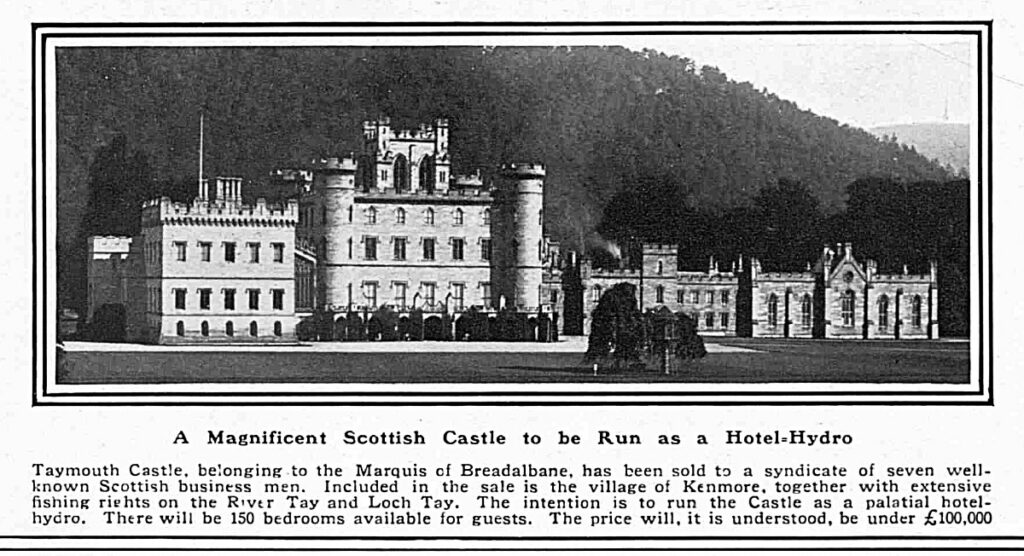
The Glasgow consortium’s plans for the estate were at last made public in April 1922 – Taymouth Castle was to be converted into a luxury hydropathic hotel. Their ambitious plans were announced in The Scotsman, along with the revelation that the purchase had been achieved at a fraction of Sir Gavin’s original asking price.
GLASGOW SYNDICATE BUY TAYMOUTH CASTLE
Purchase Price, £20,000 (approximately £1.5 million today). Tavmouth Castle, the Marquis of Breadalbane’s Perthshire seat, is to become a hotel, the historic building having been purchased by the Taymouth Castle Hydro-Hotel Company Ltd., which has been constituted in Glasgow. Ex-Bailie Wilson, of Glasgow, made the purchase on behalf of the Company during the weekend, along with Mr John Sinclair, of Kenmore, a former Councillor of Glasgow. The Company’s project includes the laying out of a golf course between the castle and the village of Kenmore, boating, curling, and twelve hard tennis courts. There will be fishings for the guests in the reserved areas of the Loch and the river, which have never been fished publicly before. Autumn shooting parties will be organised, and spring fishing parties.
Unfortunately, the sales contract with the new Taymouth Castle Hydro-Hotel Company Ltd did not include the castle’s abundant collection of artefacts. If the new company wished to ensure any mementoes of the castle’s history remained in situ, they would need to bid for them at auction, alongside the general public. Interest in obtaining a souvenir of the castle’s rich history was huge, as The Scotsman reported:
22 April 1922. VISITORS FLOCK TO TAYMOUTH CASTLE
Widespread Interest in Sale of Furnishings.
All Perthshire roads seemed to lead to Taymouth Castle, Kenmore, on Saturday, when the Castle was again open to view in connection with the six-days’ sale of furnishings. It was estimated that fully 1,500 people were within the Castle on Saturday, and over 200 motor cars passed through the entrance gates. There are 3,781 lots in the 130-page sale catalogue, and probably no larger sale has ever been held in Perthshire.
Meanwhile, Sir Gavin and Lady Alma left Taymouth Castle for the last time and returned to Craig House, Dalmally. The strain of the sale and the move from his ancestral home had clearly taken its toll on the Marquis, who was by now seriously ill. It was the beginning of the end for the Breadalbane line.
Despite frenetic bidding at the auction, the new hotel company successfully acquired the purchase of approximately £8,000 worth of furniture and fittings, including eight suits of armour, and several items from Queen Victoria’s bedroom. Perhaps most interesting, historically speaking, was the Queen’s Royal Standard, which had been raised over the castle during her visit in 1842. This was secured by the hotel for £8.
The new owners took vacant possession of the castle on 22nd May 1922, announcing that they intended to raise sufficient capital for the castle’s transformation into a hotel through the issue of 75,000 £1 shares. The Chairman of Directors, David Mason, issued a statement to the press, assuring the public of the syndicate’s good intentions.
‘We are delighted to inform you that the castle will now be known as the Taymouth Castle Hydro Hotel. With regard to the generating of electric power, it is intended to utilise a waterfall at some little distance among the hills. This power will be used for the purposes of lighting, heating, and cooking.‘
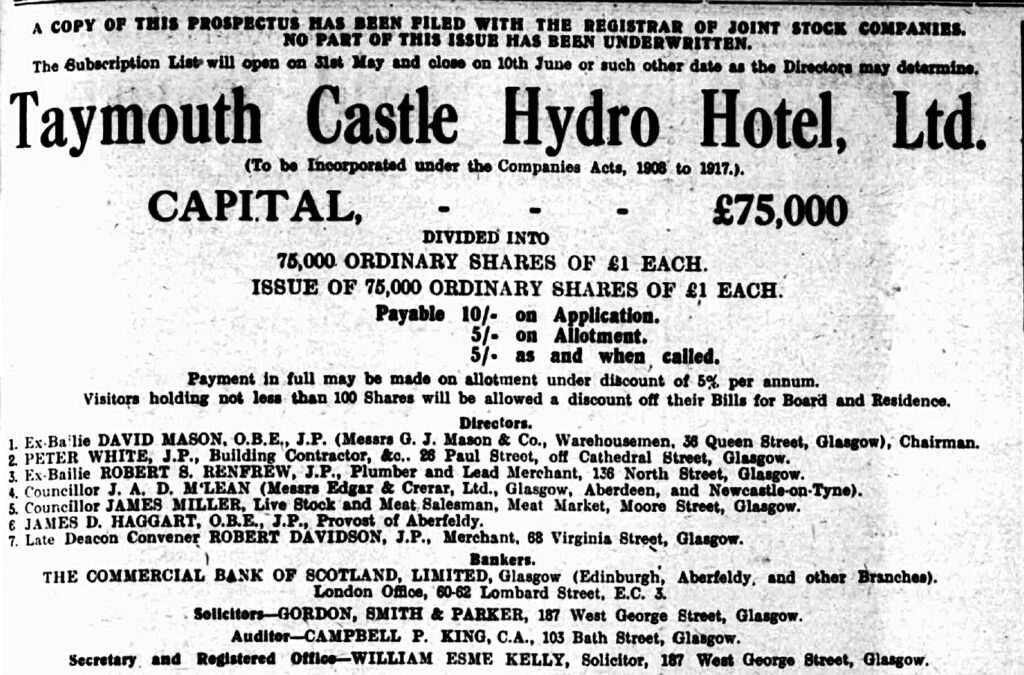
‘There is an ample supply of pure water to the Castle coming from the Black Rock at a high altitude. A mineral spring, known as “Beardy’s Well” is also on the Policies. The Castle can currently give accommodation to about 180 guests, and the intention is to greatly increase this. There is also accommodation for ladies’ maids and valets.’
Sir Gavin Campbell passed away from heart failure on 19th October 1922. He left no heir, bringing an effective end to the Breadalbane line.
Meanwhile, work continued apace to ensure the new hotel would be ready for its grand opening, scheduled for the end of May 1923. The first prospectus and advertisements appeared in the early spring, detailing some of the hotel’s attractions:
‘The interior has been modernised in respect to the sanitary arrangements, lighting and heating, and brought up to the standard of a first-class hotel, but the palatial public rooms have been left in their original condition. The terms range from 20-shillings to 40-shillings a day (between £150 – £300 today). Shooting charges are approximately £10 to £20 per stag (between £700 – £14,00 today) and 50-shillings per day for grouse and pheasant shooting. Fishing costs 10-shillings a day, for loch and river salmon and trout. There is an excellent service of trains from Edinburgh and Glasgow to Kenmore via Killin, and also to Aberfeldy, where the hotel motor meets guests.’
After several delays, the new owners finally hosted an opening weekend, including a four-course dinner for 150 invited guests, on 23rd- 24th June 1923.
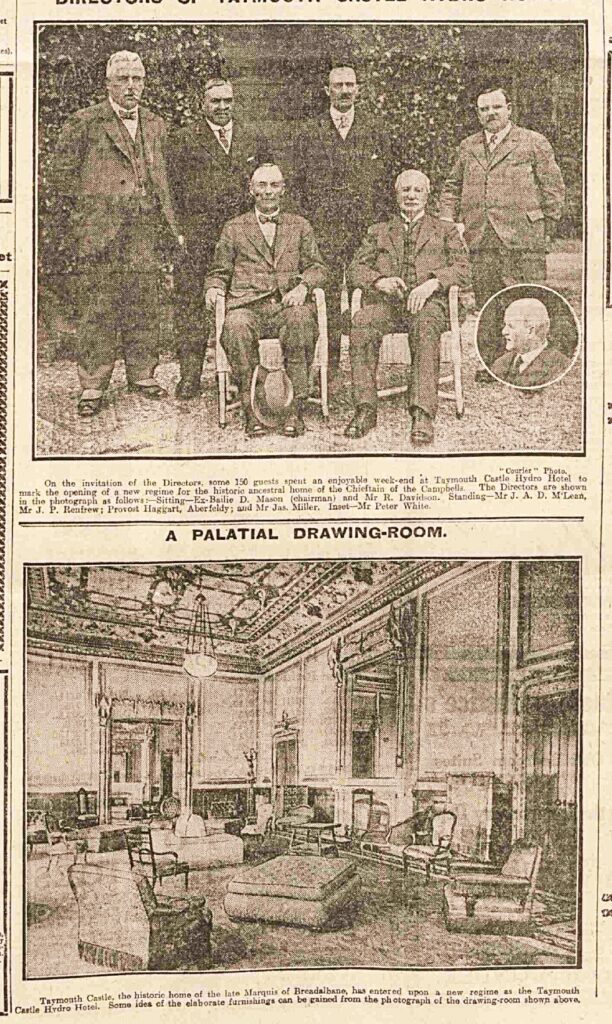
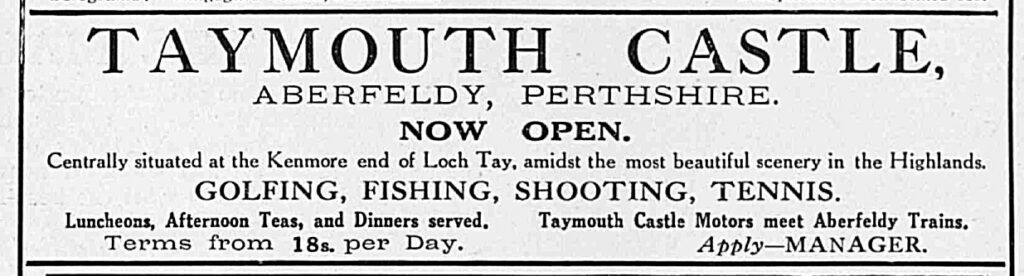
A dance orchestra was employed to play in the evenings, and the new owners undertook an extensive advertising campaign to entice visitors. This appears to have been successful, attracting guests of the calibre of Field Marshall Sir William Robinson, head of the British Army, and General Sir Robert Hutchinson, M.P. for Kirkcaldy.
Following a busy summer season, the staff at the new Taymouth Castle Hydro Hotel were treated to a charabanc trip to Crieff and Perth, which was ‘greatly enjoyed by all’.
In the autumn, telegraph services together with a telephone line (‘Aberfeldy 9’) were installed at the hotel, and a new manager was appointed for the 1924 season
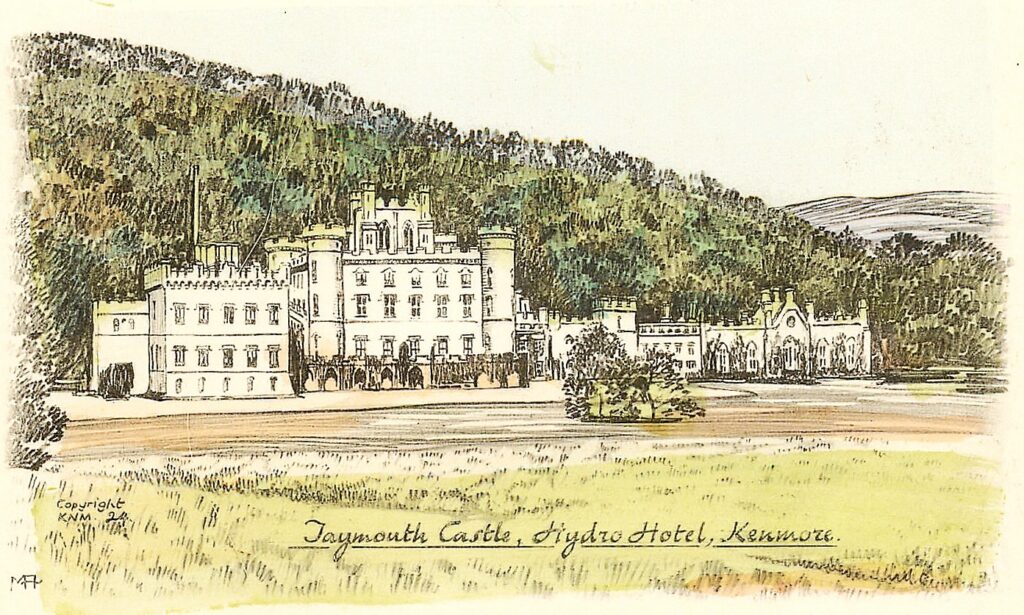
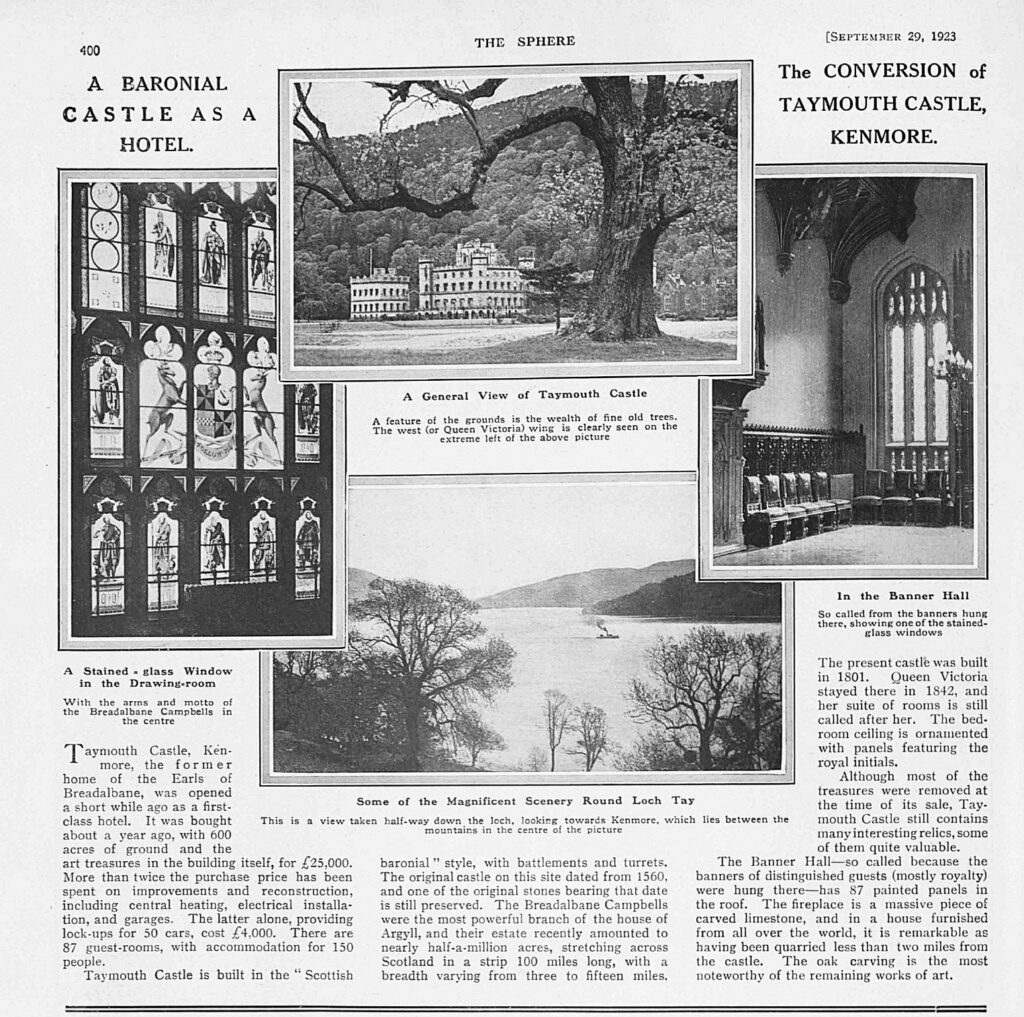
Swiss-born Nicholas Frederick came from the Gordons Hotel Group in London, and it was hoped his experience would help launch Taymouth Castle Hydro Hotel’s first full summer season.
He immediately began an extensive campaign of advertising in the likes of Country Life, Tatler and The Sphere. A new badminton court was added, and the hotel began to actively market itself as a wedding venue. With his astute eye for detail, Mr Frederick also identified that the hotel’s owners had drastically underestimated the sheer number of staff required to provide the levels of service expected from the hotel’s illustrious guests.
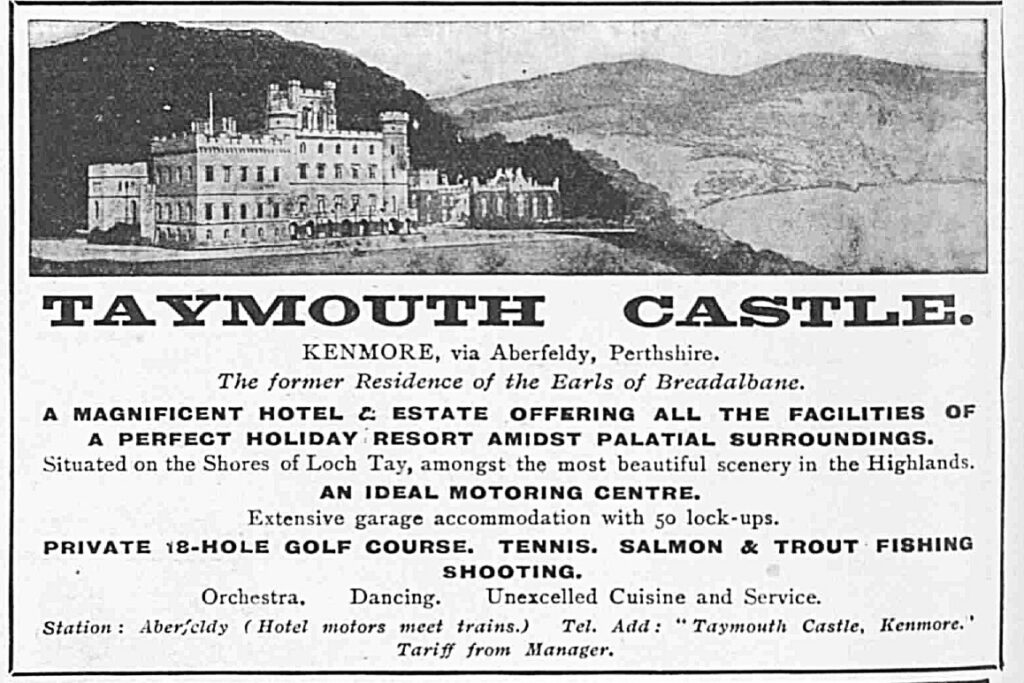
The golf course was also improved over the winter months, under the expert eye of James Braid, the famous course designer.
As a result of all these measures, bookings did increase as Easter 1924 approached; however, there was some inconvenience for the hotel when the bus from Aberfeldy to Taymouth Castle, which was conveying many of the hotel’s staff to work, was overturned when it swerved to avoid being struck by a motor-car in Aberfeldy. Several members of staff suffered minor injuries and shock.
Better news for the hotel was the valuable work undertaken by Mr Frederick to restore the lawn and footpaths on Sybilla’s Island, Loch Tay. This enabled the hotel to offer boat trips and picnics to the island as another guest attraction.
Autumn 1924 also saw a number of wealthy and influential guests staying at the new hydro hotel, including Sir John Simon, one of only three men in history to hold the roles of Home Secretary, Foreign Secretary, and Chancellor of the Exchequer; Sir Milton Sharp, millionaire textile magnet, Frank Kellogg, United States Ambassador, Vallance Crisp Jupp, the England Test cricketer, and Brigadier-General Herbert. R. Done.
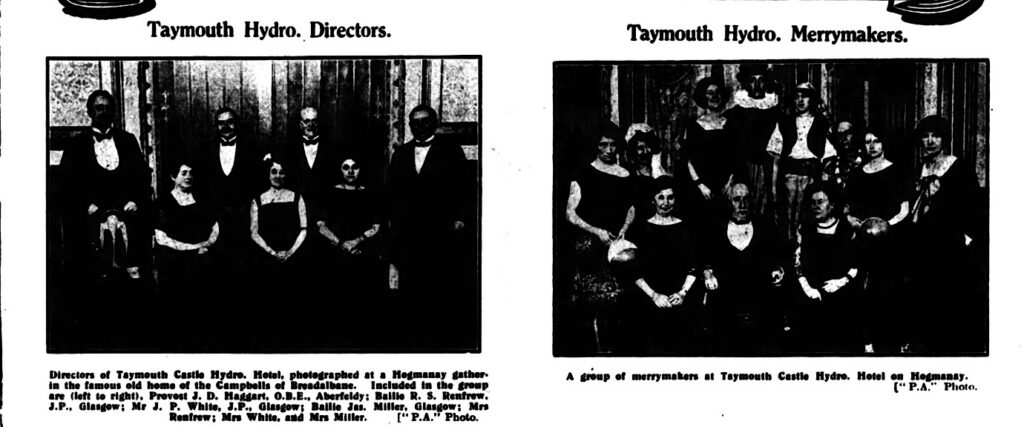
The season ended with the throwing of the hotel’s first Grouse Ball. An opportunity for the landed gentry and wealthy landowners, who had spent that shooting season in Scotland, to see and be seen. The event was the most glamorous and opulent social occasion held at Taymouth Castle since the visit of Queen Victoria eighty-two years earlier. Exquisite details of the fashions, etiquette, and social deference of an epoch long gone were beautifully captured in the Dundee Courier on 20th September 1924:
‘TAYMOUTH CASTLE REVELRY GALAXY OF COLOUR AT GROUSE BALL
Sheathlike Frocks and Shoulder Posies in Favour
The stately and magnificent Taymouth Castle, occupied until recently by the Breadalbane family, and now converted into one of the most palatial and popular hotels in Scotland, was last night given over to music, dancing, and joyous festivity.
For miles around came many well-known ladies and gentlemen. The polished parquet floor is ideal for dancing, and Miss Grant Donaldson’s Orchestra, from Edinburgh, commenced to play and when the dancers took the floor, the spectacle was a really beautiful one. The majority of the ladies wore the new sheathlike frocks along with shoulder posies.
Lady Wills’ Party.
A large party came with Lady Wills, who wore black with a long train and georgette sleeves. Her gown had elaborate bead decorations in black and silver. Mrs Baxendale had a beautiful creation of white diamante with heavy bead fringe and scarf of absinthe green tulle.
Mrs Prioleau wore a sheathed frock and delphinium matalassi designed all over in the Brique style. Miss Wills had chosen smart dress of flesh pink Nottingham lace with motifs carried out in crystal and seed pearls.
From Killlechassle.
From Killiechassie House were Mrs and Miss Chadwick, Mrs G. B. Holesworth, Mrs and Miss Wells, and Mr Simpson Hinchliffe. Mrs Chadwick looked well in pearl grey georgette, while her daughter wore wedgewood ninon over jade, the waist encircled in pink rosebuds; from the shoulders were two long scarves finished with tassels and fastened with rosebuds. Early in the evening a variety of fantastic articles suitable for carnival were distributed, after which supper was served. Dancing continued well into the morning.’
With the benefit of hindsight, we can now say that the Taymouth Castle Hydro Hotel undoubtedly reached its high point of success, profile, and popularity at the end of the 1924 season. Mr Frederick wired the owners in Glasgow to gleefully report:
‘Hotel full to capacity. Excellent shooting. 45 brace of grouse. Other game. Birds strong. No signs of disease. – N.F.’
Sadly, the summer of 1925 would see the hotel’s fortunes change drastically.
It was hoped that the opening of the salmon season in 1925 would bring a glut of visitors to the Hydro Hotel, but heavy rain and strong gales meant that no boat dared venture out on the Loch or River Tay.
Although the golf course received excellent reviews, scandals involving theft by staff (for which one of the hotel’s porters was imprisoned), widespread poaching on the estate, and persistent inclement weather dented the hotel’s reputation. Even the manager, Mr Frederick, was not immune. Following the death of an elderly female guest, it was discovered that Mr Frederick had benefited excessively from the lady’s will – much to the chagrin of her descendants. Mr Frederick’s windfall saw him inherit today’s equivalent of more than £160,000, which he then used to purchase a large tranche of shares in the hotel!
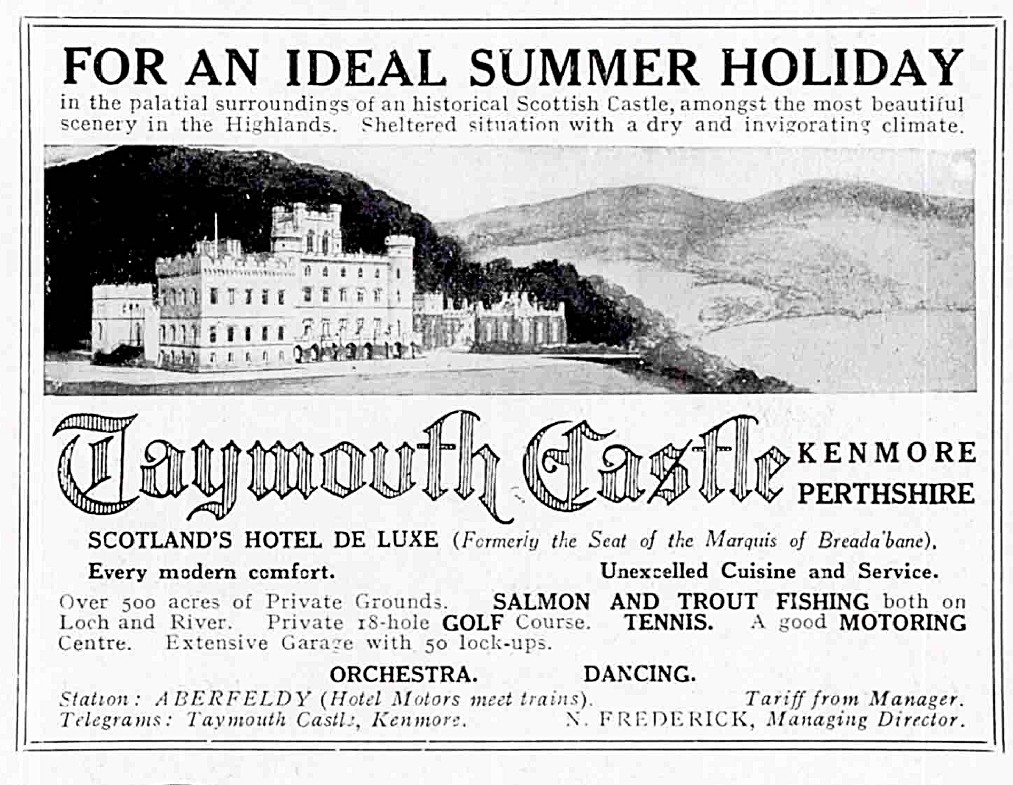
You will note that little mention was made of hunting in the hotel’s promotional campaigns. This was due to an error in the owner’s application for a hunting licence. Technically, hunting was not actually permitted until the correct permit was granted in summer 1925, and all residents taking part before that date had, in fact, been breaking the law.
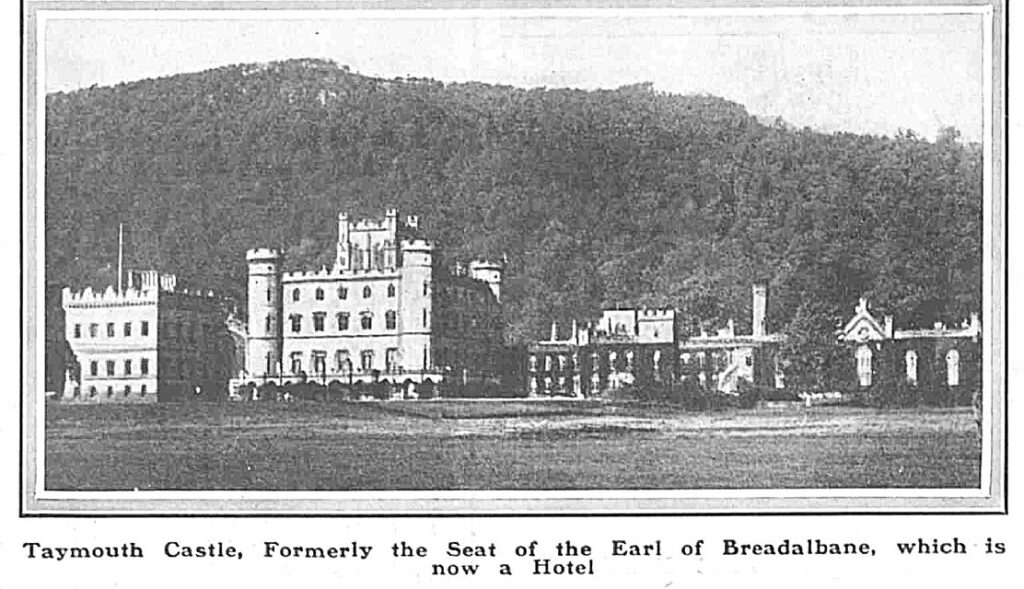
The standard and quality of the Taymouth Castle Hydro Hotel, under the management of Mr Fredericks, seems to have been of the highest order. The Jack Muir Dance Orchestra from Glasgow entertained guests throughout the summer, and built an enviable reputation – enough to be chosen to appear on the new BBC Scottish Radio broadcasts.
However, disaster struck on ‘Glorious Twelfth’, when the castle was packed with expectant guests all keening, awaiting the call to hunt. Great floods at the end of May had drowned nearly all the early broods, and disease was rife among many of the older birds on the moors surrounding Lochtayside. The first hunting trip produced only twenty birds (on moorland that had yielded 700 during the previous year).
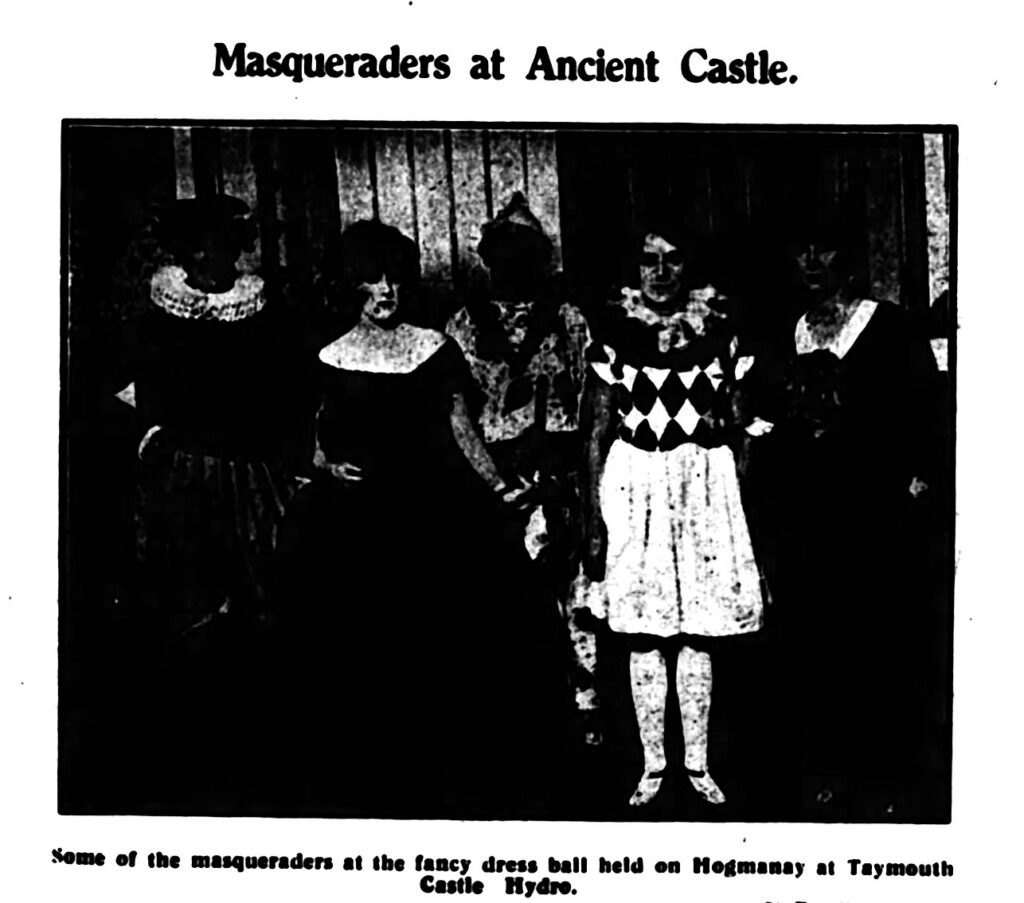
Despite this disappointment, the 1925 shooting and summer season finished with a ‘Merry Masqueraders’ Fancy Dress Ball’ in the Banner Hall, in which many breathtaking and imaginative costumes were unveiled.

Another noisy affair, which made its first appearance at Taymouth Castle in September 1925, was the Charleston. Miss Belle Harding, the famous New York-trained dance teacher who had brought the Charleston dance craze to Britain, visited the castle and remarked,
‘Scots people pick up the new fox-trot variation, the ‘‘Charleston,” much more quickly than any other of my pupils. The toe and heel steps in this new dance come easy to northerners, whose training in reels and flings has accustomed their feet to toe and heel movements. The “Charleston” will certainly take its place in fashionable ballrooms this winter. Something different to the fox-trot and the one-step has been wanted, and this new variation fills the gap. At Taymouth Castle last week I found everyone dancing to it with enthusiasm. It was introduced there by one of my London pupils.’
However, the Charleston could often become raucous, leading to complaints from other hotel guests. On such occasions, a sign was put up in the ballroom requesting visitors to ‘PCQ’ – Please Charleston Quietly.
Taymouth Castle remained open for the Christmas Holidays, before the ‘London Crowd’ eventually left and the staff drifted away. However, a shock announcement in March 1926 took both the employees and guests who had already booked for the summer by complete surprise
Following the return of the ‘London Crowd’ to the Capital, the hotel closed to guests on 5th January 1926, although the castle was made available for a number of wedding receptions during the winter. This also provided another valuable income stream.
The arrival of the salmon fishing season also provided some bumper catches along the
Then, in March 1926, completely out of the blue (at least, for the staff) came the following shocking announcement:

‘Proposal to Wind Up Company.
Former Seat of the Breadalbanes
An extraordinary general meeting of the shareholders in Taymouth Castle Hotel Ltd., has been called for Monday, 29th March, for the purpose of considering and, if deemed expedient, passing the following extraordinary resolution:- ” That it has been proved to the satisfaction of this meeting that the Company cannot, for reason of its liabilities, continue its business, and that it is advisable to wind up the same, and accordingly that the Company be wound up voluntarily.”

To be continued . . .
Written with thanks to Mark Bridgeman